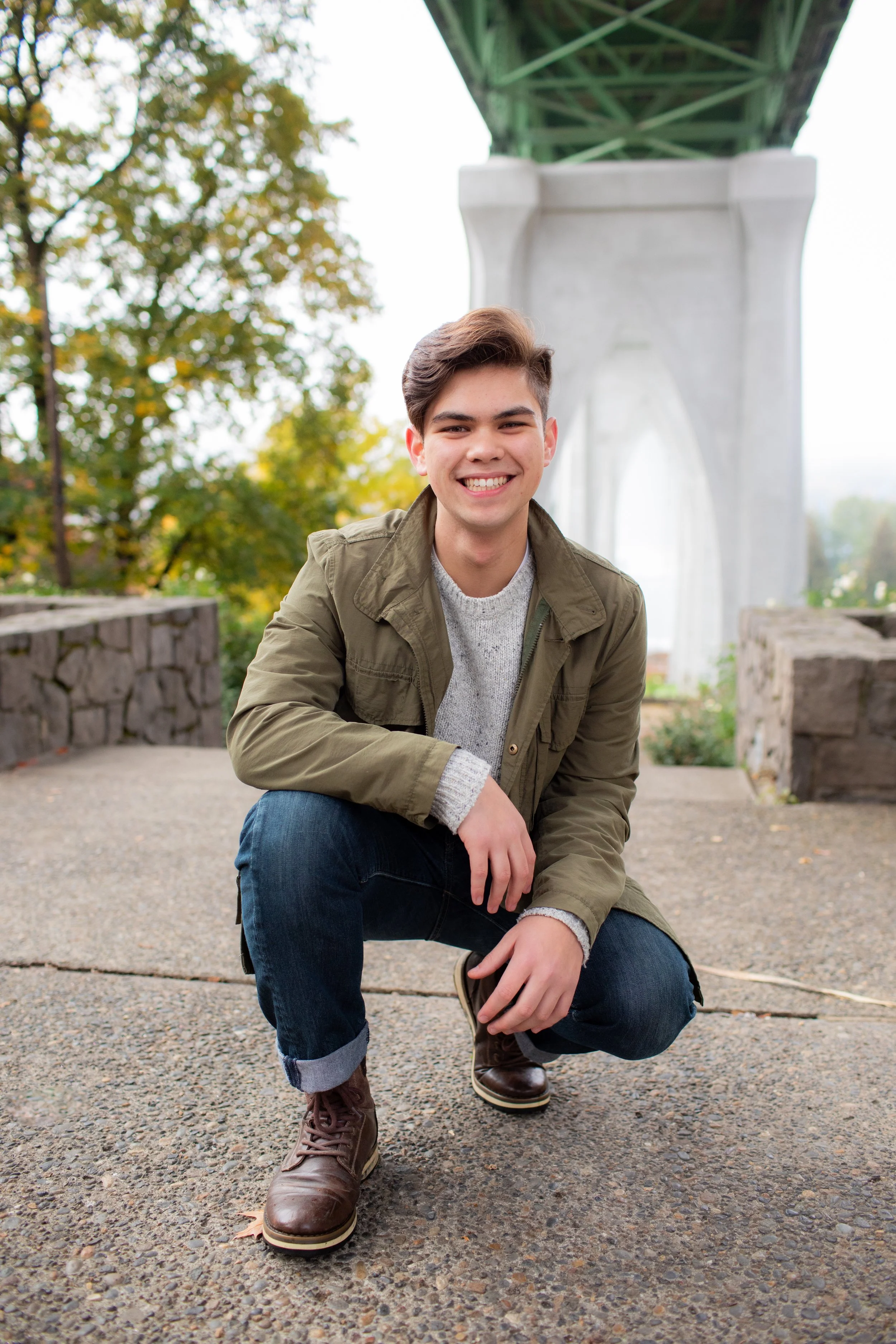
Patrick igloria
What is your first memory of Trinity?
My first experience I had with Trinity was actually the junior play in 2018. My next-door neighbor Gladys was playing Viola in Twelfth Night. I remember Dr. Clark meeting my family when we came in. I recognized her from my church, but I didn't know exactly who she was. I remember that she was very friendly and welcoming.
Is there a story that sheds some light on your Trinity experience?
My tenth grade Humane Letters oral exam was one of the greatest events of my life thus far! I really connected with the HL 10 course as a whole. The questions it posed about modern society went with questions I already had. I am religious and was really concerned about the state of the world. These past years have felt like a very political time for teenagers. I thought, what can the Church do in the world that we have? To what extent would I wish things were back where they were? How much progress do I think has actually been good? In the oral exam, it felt very freeing to take everything I’d been thinking about the whole year, everything I wanted to wrestle with, and try to work through it all.
Are there classes at Trinity that have not come as easily for you?
I don’t have a natural talent for art. At a young age, I decided to never draw so that no one would find out I couldn’t do it. So embarking on art in middle school was a challenge. The key was not to think about “being an artist.” I learned to do a grid square at a time, very methodical. Watercolor was the most difficult thing I ever did at Trinity. It’s so antithetical to how I want everything to go. It’s uncontrolled, and the water goes wherever it goes. Mrs. Mbona made me practice over and over on scrap pieces of paper, until I finally gained a feel for it and learned to just go for it. In the end, it’s really valuable to me to have learned it. It’s like reading Einstein right now in Physics – It’s awesome to feel able to grasp something like the theory of relativity because we’ve built up our understanding in class to the point where we’re able to be conversant. Not that we’ve reached mastery of everything we’ve learned at Trinity, but I’ve had an experience of my own competence.
Do you have a favorite Trinity Academy tradition?
I love taking dance lessons together. You get to interact with members of the high school that you otherwise wouldn't as often. They can start out a little awkward, but I think that nicely transitions into a bonding experience unlike any other. You learn to just have fun and not take yourself too seriously.
What extracurriculars did you participate in? What have those experiences added to your life?
I’ve been in Taco, Trinitones, and Chamber Choir. Making music with people is an experience like no other. There's no real competition (beyond some light section versus section rivalries). It's all about collaboration and coming together to create something larger than all of your individual talents. I love the way you connect with other people in a musical group setting. It's totally nonverbal. You learn to listen to each other and feel each other's beat and energy. When it is really great, you don't say anything, you can't even look at each other really, especially reading orchestra music, but you literally feel your sound mixing together and you just know that you are creating something big and glorious. Also, the last few years I’ve been working at a performing arts dance camp. I choreograph dances for third graders set to Taylor Swift songs.
What was your favorite book from Humane Letters?
The Brothers Karamazov is becoming a strong contender, but for now I think I have to stick with Crime and Punishment. I remember being shocked at how relatable Raskolnikov was in his experience of guilt and his desire to be something extraordinary. With Dostoevsky, you feel the importance of what he is saying, and you can almost tell what he is getting at, but he just doesn't say it outright. He leaves you to put the last pieces together.
What has been your experience of the Christian character of Trinity’s academics?
At Trinity, you have to encounter Scripture directly, and ask, what exactly does this say? You have to think about what the words are for a second, and not just what you’ve been told they mean. As a Catholic, I believe all the things that I was raised to to believe, but now they are mine in a different way. Trinity helped me have conviction.
What advice would you give to an incoming student (one very much like yourself) about how to get the most out of Trinity?
I would say to remember that teachers at Trinity really want you to have an encounter with subjects that they find really meaningful. I spent a good part of my schooling feeling like I had to earn my teachers’ approval—like they would be disappointed in me if I wasn't acing every test and spending hours and hours getting through every homework assignment. I ended up doing a whole lot of worrying and stressing about the way I was perceived, when, in reality, my teachers wanted to see my interest, not my overwhelming productivity.
What’s next for you? What do you hope it will be like?
I will be going to Hope College in Holland, Michigan in the fall. I'm very fortunate to have been accepted into a program they have called Hope Forward. The members of the program are put into a cohort, and you do retreats and seminars and service work and other things like that. So I am very excited to meet my fellow cohort members. I really hope that I will be able to have conversations with people about what they are interested in learning and what issues are important to them.